
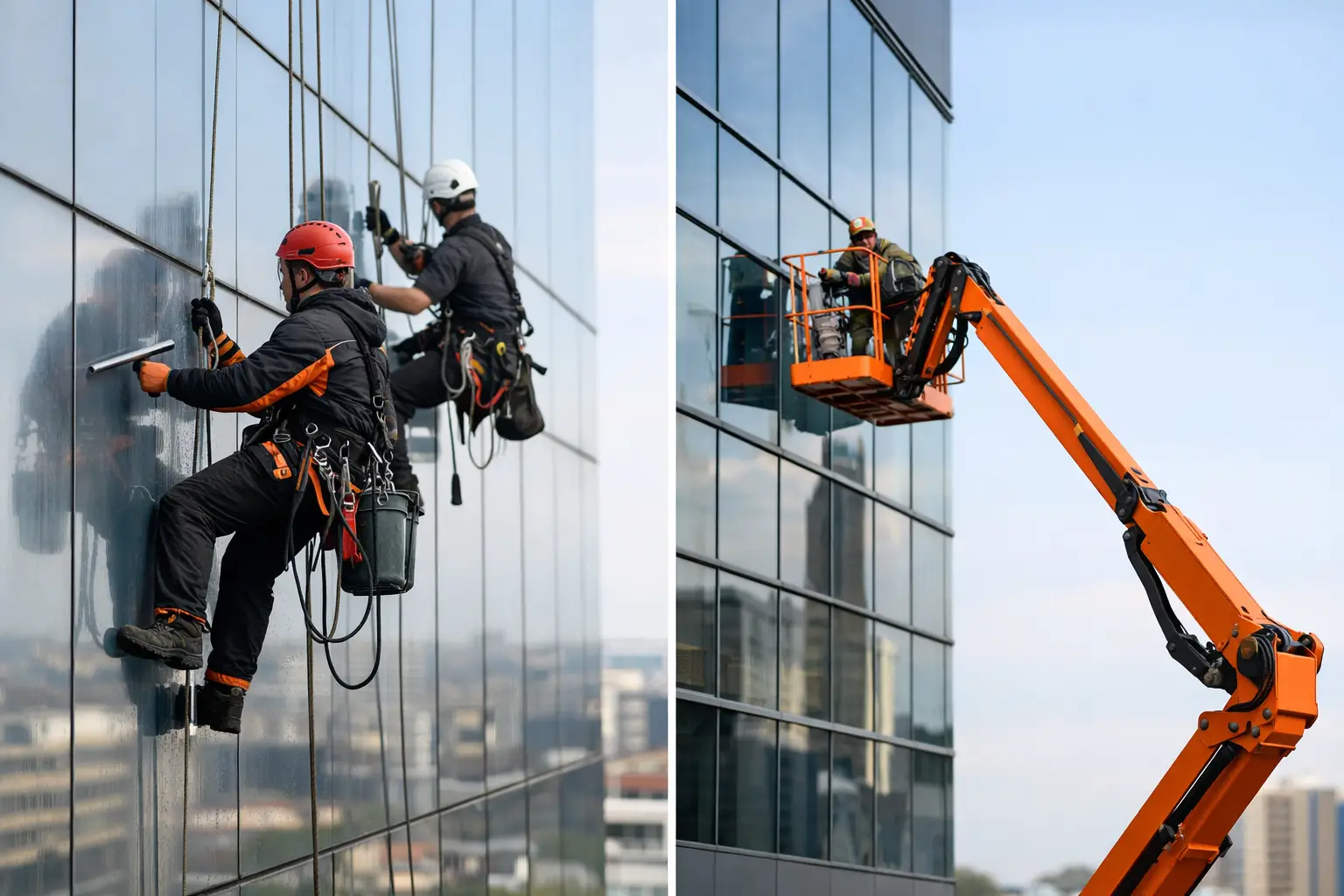
A facade inspection identifies sealant failure on the upper stories, staining around window frames, and localized corrosion behind architectural fins. The access method selected next will affect more than the work schedule. In the decision between rope access versus boom lifts, building managers must consider how each option reaches the defect, protects the facade, affects occupants, and supports safe execution.
Neither method is automatically better. Rope access and boom lifts are established ways to work at height, but they solve different site conditions. The correct choice begins with a clear scope of work, a proper risk assessment, and an understanding of the building’s facade system.
Rope Access Versus Boom Lifts: The Core Difference
Rope access uses certified technicians who descend or position themselves from secure roof anchorage systems. They work with independent working and safety lines, specialized harnesses, descenders, and fall-arrest equipment. This approach allows technicians to access vertical facade areas with a small operational footprint.
Boom lifts, also called mobile elevated work platforms, raise personnel in a platform from ground level. Articulating or telescopic booms can reach around obstacles and provide a stable work basket for people, tools, and materials. They require suitable ground conditions, access routes, setup space, and an exclusion area around the machine.
For a high-rise office tower in Kuala Lumpur or a dense residential development in Selangor, that difference is significant. A rope team may begin work from the roof with limited impact at ground level. A boom lift may be highly effective on a lower facade, but it can require lane management, parking restrictions, and coordination with building users before it can be deployed.
When Rope Access Is the Stronger Choice
Rope access is particularly effective where the work area is high, narrow, irregularly shaped, or difficult to reach with equipment from the ground. It is often used for facade cleaning, visual inspections, sealant assessments, localized repairs, waterproofing investigations, and targeted restoration work.
Access to Complex Building Geometry
Modern facades rarely present a simple, flat elevation. Recessed windows, projecting fins, curved glass, canopies, setbacks, crown features, and narrow side elevations can all limit a boom lift’s ability to get close enough to the work surface. Rope access technicians can be positioned with greater precision, provided the roof structure and anchorage arrangement have been assessed and approved for the task.
This is especially valuable when a defect is isolated. If water staining appears around several curtain wall joints on the 25th floor, bringing a boom lift across the entire site may be disproportionate to the repair. A rope access team can focus directly on the affected elevations while allowing the rest of the property to operate normally.
Reduced Ground-Level Disruption
Boom lifts need space. On constrained sites, the required footprint can interfere with vehicle circulation, visitor parking, retail frontages, loading bays, landscaping, or emergency access. Ground protection may also be needed to prevent damage to paving, drainage covers, and soft landscaping.
Rope access reduces these demands, although it does not eliminate the need for ground controls. A safe exclusion zone below the work area remains necessary to manage falling-object risk. The difference is that the zone can often be smaller and more flexible than the operational area required for a mobile lift.
Close Control Around Delicate Facade Features
For heritage details, fragile cladding, decorative screens, and areas with limited tolerance for contact, rope access can offer a controlled approach. Technicians can work close to the surface without positioning a large machine beside it. Protection measures still matter: rope paths, edge protection, tool lanyards, and contact points must all be planned to avoid abrasion or accidental damage.
Rope access is not simply a way to get people down a building. It is a disciplined access system that depends on competent technicians, documented procedures, inspected equipment, appropriate anchors, rescue planning, and supervision.
Where Boom Lifts Offer a Clear Advantage
Boom lifts are often the better option when work requires a stable platform, extensive material handling, or prolonged hands-on repairs. Their value is not just height. It is the working space and load capacity they provide at the facade.
Heavier Repairs and Equipment-Intensive Work
Some facade works need more than a technician and hand tools. Replacing larger panels, conducting substantial sealant removal, carrying repair equipment, or handling bulky components may be impractical or unsuitable from ropes. A boom lift platform gives the team a stable place to organize materials and perform detailed work without repeated hoisting from the roof or ground.
The platform can also be useful when two or more workers need to operate side by side for an extended period. That can improve control during certain repair procedures, particularly on lower to mid-rise elevations where the machine can reach the required height and position.
Broad, Repetitive Work on Accessible Elevations
If a building has an open perimeter, firm level ground, and a large area of similar facade work at reachable heights, a boom lift may be highly productive. It can be repositioned along an elevation while workers complete repeated tasks from a stable basket.
This does not mean every low-rise or mid-rise project should default to a lift. Trees, overhead power lines, slopes, basements, underground services, canopies, and narrow driveways can change the assessment quickly. Machine reach on a specification sheet is not the same as usable reach on a live site.
Safety Depends on Planning, Not the Equipment Alone
A common mistake is to describe one method as safe and the other as risky. Both rope access and boom lifts carry serious work-at-height responsibilities. Safety comes from matching the method to the task and applying the controls required for that method.
For rope access, key considerations include the integrity and suitability of anchorage points, edge protection, rope routing, weather limits, dropped-object prevention, communication, and a site-specific rescue plan. Teams must be trained and competent in rope access procedures, not merely comfortable working at height.
For boom lifts, the assessment must address ground-bearing capacity, slope, proximity to overhead hazards, machine inspection, operator competency, platform loading, wind conditions, barricading, and traffic management. Outriggers, where used, require careful positioning and adequate support.
Malaysia’s tropical weather adds another operational consideration. Sudden rain, lightning activity, and strong winds can interrupt facade work and create unsafe conditions. Responsible planning includes weather monitoring and clear stop-work criteria for both access methods.
Protecting the Facade While Carrying Out Work
Access decisions should support the condition of the facade, not create new maintenance issues. A boom lift can cause damage if its basket, boom, or materials come into contact with glazing, louvers, cladding edges, or architectural projections. It also requires careful movement near landscaped areas and podium finishes.
Rope access has its own facade protection requirements. Poorly managed ropes can rub against edges, coatings, or glazing. Improper anchorage use can transfer loads where the building was not designed to receive them. Technicians should assess contact risks before mobilization and use protective measures appropriate to the facade materials.
This is why facade knowledge matters. Curtain wall systems, stone cladding, aluminum composite panels, painted render, terracotta, and heritage finishes respond differently to cleaning methods, access loads, and repair activity. The team selecting the access method should understand the exterior system being maintained, not only the equipment being used.
How to Choose the Right Access Method
The decision should be based on the actual work package rather than a general preference. Start with the location and extent of the issue. Is the work localized at upper levels, spread across a broad elevation, or concentrated around a difficult architectural feature?
Next, assess the building itself. Review roof access, certified anchor points, facade geometry, ground space, underground structures, public areas, and operational constraints. A site survey should also consider what must be moved, lifted, cleaned, repaired, or tested once workers reach the facade.
Finally, consider disruption and duration. Rope access is often effective for targeted, high-level tasks with limited ground access. Boom lifts can be appropriate for accessible elevations requiring stable platform work or heavier materials. Some projects benefit from both methods, with rope access used for upper levels and boom lifts assigned to lower, equipment-intensive sections.
A Facade-First Decision Delivers Better Results
The question is not whether rope access or a boom lift is more impressive on site. The practical question is which method allows qualified personnel to complete the required facade work safely, accurately, and with the least unnecessary impact on the property.
A professional assessment before work begins gives property teams a clearer path forward. When access planning is aligned with facade condition, building operations, and safety controls, maintenance work becomes a measured part of protecting the asset rather than an avoidable disruption.
Discuss the next step
For advice on rope access vs boom lift, request a site assessment or quotation from Vertical Pro.
For rope access work, planning, supervision, competence and equipment need to operate as one system. IRATA International’s overview of rope access explains why each part matters to safe execution.



Leave a Reply