
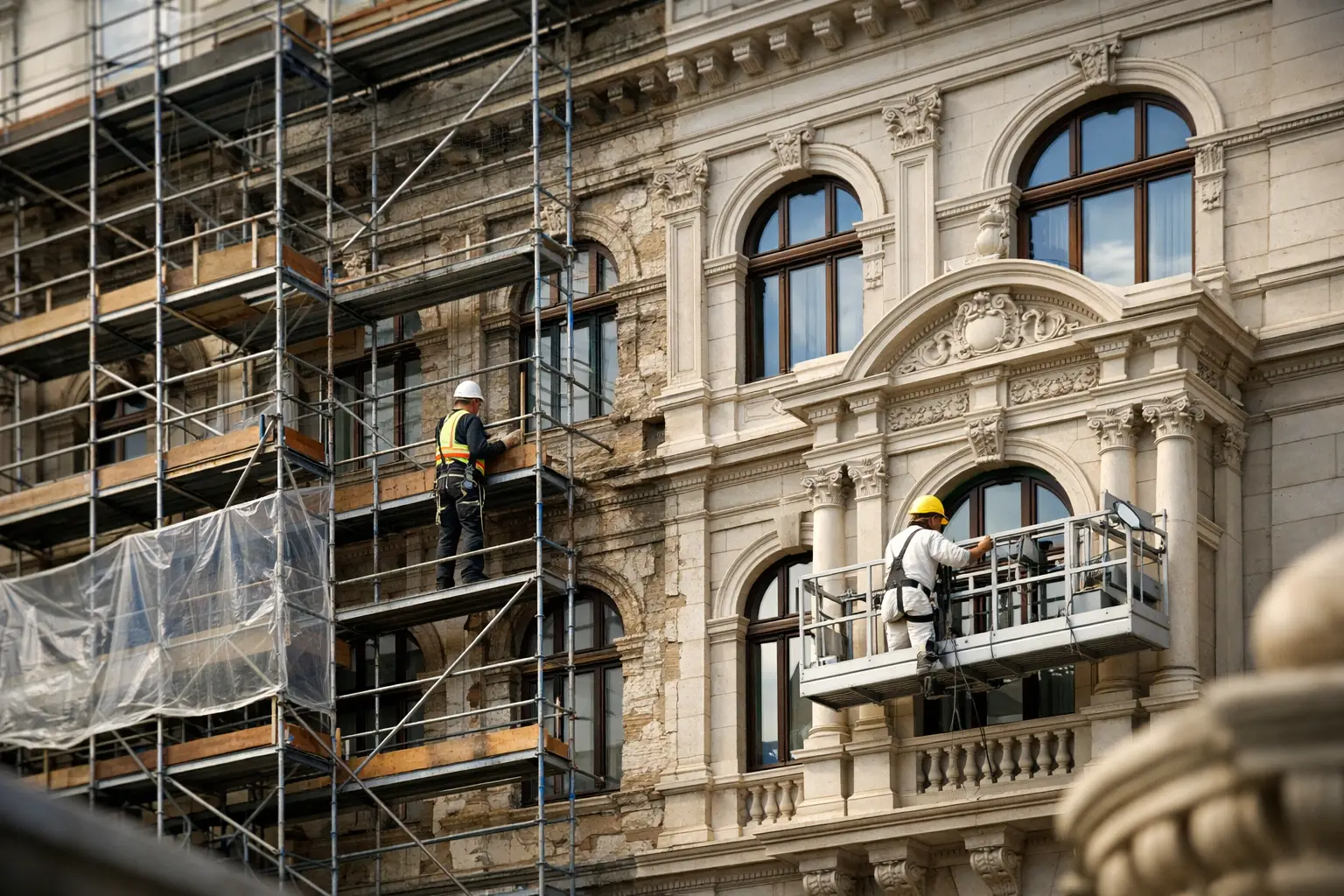
For heritage facade restoration, the practical starting point is a condition review that records materials, defects, exposure and access before the scope is fixed.
Heritage Facade Restoration: What to Check on Site
Plan how the completed work will be checked. Photographs, defect maps and agreed acceptance criteria help the building team verify the result.
When a heritage facade starts showing cracks, staining, biological growth, failed sealants, or loose surface materials, the problem is rarely just cosmetic. Heritage building facade restoration is about protecting architectural identity while addressing water entry, material decay, and safety risks before they spread into larger structural and operational issues.
For owners, building managers, and asset stakeholders, the challenge is that older facades do not respond well to generic repair methods. A repair approach that works on a modern curtain wall or painted concrete tower can permanently damage lime plaster, aged masonry, ornamental details, or historic render systems. The work has to respect the original building fabric, but it also has to perform in active urban conditions where rain, heat, pollution, and moisture cycles accelerate deterioration.
Why heritage building facade restoration needs a different approach
A heritage building carries two responsibilities at once. It must remain safe and serviceable as a functioning asset, and it must retain the visual character that gives it cultural, architectural, or civic value. Those goals usually align, but not always in a simple way.
For example, aggressively removing stains may improve appearance in the short term, yet the wrong cleaning pressure can erode the surface layer that protects older masonry. Replacing damaged sections with newer materials may seem efficient, but mismatched density, porosity, or thermal behavior can trap moisture and cause faster breakdown around the repair area. In facade work, compatibility matters as much as appearance.
This is especially relevant in Malaysia, where heavy rainfall, strong UV exposure, humidity, and urban pollution place continuous stress on exterior surfaces. Moisture does not need a dramatic opening to create damage. It can enter through hairline cracks, failed joints, porous render, or previous repairs that were never suited to the original facade system.
Common facade problems seen in heritage properties
Most deterioration starts quietly. Surface discoloration, minor cracking, or localized biological growth can look manageable from ground level, but elevated sections often tell a different story once inspected up close.
In heritage properties, common facade defects include spalling render, detached plaster, open joints, salt deposits, rust staining from embedded metal, failed repainting systems, and water-driven staining below ledges or decorative projections. Older repairs are often part of the problem. Cement-rich patching over softer substrates, incompatible paints, and poorly detailed sealant work frequently create new stress points.
Decorative features also need close attention. Cornices, moldings, parapets, and ornamental bands are more exposed than flat wall surfaces because they hold water, collect dirt, and experience repeated thermal movement. If these areas are neglected, deterioration can shift from visual wear to falling-fragment risk.
The first step in heritage building facade restoration
Good restoration begins with diagnosis, not repair. Before any cleaning, patching, or recoating takes place, the facade should be assessed in detail to identify material types, defect patterns, moisture paths, and areas of instability.
A proper assessment usually combines visual inspection, close-up access, condition mapping, and sounding or non-destructive checks where needed. The purpose is to separate symptoms from causes. A stained wall may actually indicate failed drainage detailing above. Recurrent cracks may reflect movement at joints rather than a simple surface defect. Peeling paint may be a moisture problem, not a paint problem.
This stage is where many projects go right or wrong. If the root cause is missed, the restored surface may look improved briefly, then fail again under the same conditions. For active commercial and residential assets, repeated facade work means avoidable disruption and greater long-term maintenance pressure.
Cleaning is part of restoration, but not the whole job
Cleaning often plays a major role in heritage building facade restoration, but it should never be treated as a standalone fix. The cleaning method has to be chosen based on the substrate, finish condition, and type of contamination.
Soot, biological growth, mineral deposits, and traffic-related grime each respond differently. The gentlest effective method is usually the right starting point. Excessive pressure, harsh chemistry, or abrasive treatment can strip protective surface layers, widen pores, and expose fragile finishes to faster weathering.
In some cases, uneven appearance after cleaning is not a failure of the process. It may reveal earlier patch repairs, differential weathering, or hidden material variation that was previously masked by dirt. That is why cleaning should be coordinated with repair planning rather than treated as a separate cosmetic exercise.
Repairing original materials versus replacing them
One of the most important decisions in restoration is knowing what can be retained. Preserving sound original fabric is usually better than replacing it, provided the material still performs safely and can be stabilized.
This does not mean every damaged section should be saved at all costs. Some elements deteriorate beyond reliable repair, especially where corrosion, prolonged saturation, or loss of section has already compromised integrity. The right decision depends on condition, function, exposure, and heritage significance.
Where replacement is necessary, matching appearance alone is not enough. The replacement material should be compatible in strength, movement, and moisture behavior. A hard, dense repair inserted into a softer surrounding facade can create edge cracking or redirect moisture into adjacent original areas. The result may look neat at handover but perform poorly over time.
Access strategy matters more than many owners expect
Heritage facades often include projections, recesses, towers, parapets, and decorative zones that are difficult to inspect or repair from conventional access points. On occupied properties, access planning also has to account for public safety, building operations, and minimal disruption.
This is where specialized facade contractors bring real value. Rope access, when properly planned and executed, allows technicians to reach complex vertical surfaces with a high level of precision and less dependence on bulky access systems in certain conditions. It is not the answer to every project, but for targeted inspection, localized repair, and difficult elevations, it can significantly improve efficiency and control.
For taller or more constrained buildings, access is not just a logistics issue. It influences inspection quality, repair accuracy, and whether small defects are fully addressed or simply worked around.
Documentation, compliance, and long-term asset care
A heritage restoration project should leave behind more than an improved facade. It should also produce clear records of condition, scope, repair locations, materials used, and areas that need future monitoring.
That documentation helps owners and facility teams move from reactive repairs to informed maintenance planning. It also supports continuity when building management changes or when future defects appear in related areas. On heritage assets, continuity matters because facade condition often evolves gradually over many years rather than through one major failure event.
Compliance and approvals may also shape the project approach, depending on the building status and local requirements. That makes early planning especially important. Restoration teams need to balance conservation intent, safety needs, access limitations, and building use without forcing a generic solution onto a specialized asset.
What building stakeholders should look for in a restoration partner
Not every exterior contractor is equipped for heritage work. The right partner should understand facade pathology, material compatibility, safe work at height, and the operational realities of occupied buildings.
Just as important, they should be willing to explain why a certain treatment is suitable and where the limitations are. In heritage restoration, there is rarely one perfect answer. There are trade-offs between retention and replacement, visual consistency and material honesty, short-term correction and long-term performance. Clear technical reasoning is a sign of real expertise.
For buildings with complex elevations or hard-to-reach defects, practical access capability is essential. A team that can inspect closely, document accurately, and execute repairs safely is better positioned to preserve both facade appearance and service life. That is the standard asset owners should expect from specialists such as Facade by Vertical Pro Sdn Bhd.
Heritage building facade restoration as a management decision
It helps to view restoration as part of asset stewardship, not as an isolated repair event. A heritage facade shapes public perception, tenant confidence, and the overall standing of a property. More importantly, it acts as a protective envelope that must continue performing under weather exposure year after year.
When restoration is approached carefully, the building keeps its character without sacrificing safety or durability. When it is delayed or handled with incompatible methods, even small defects can become expensive operational problems in the form of water ingress, falling hazards, interior damage, and repeated patchwork.
The best time to act is usually before deterioration becomes obvious from the street. A well-timed inspection and a technically sound restoration plan can preserve what makes the building worth keeping in the first place.
Discuss the next step
For advice on heritage facade restoration, request a site assessment or quotation from Vertical Pro.
Before appointing a method of access, assess the task, exposure, working area and emergency arrangements. DOSH Malaysia’s fall-prevention guidance explains the fall-prevention principles that support this review.




Leave a Reply