
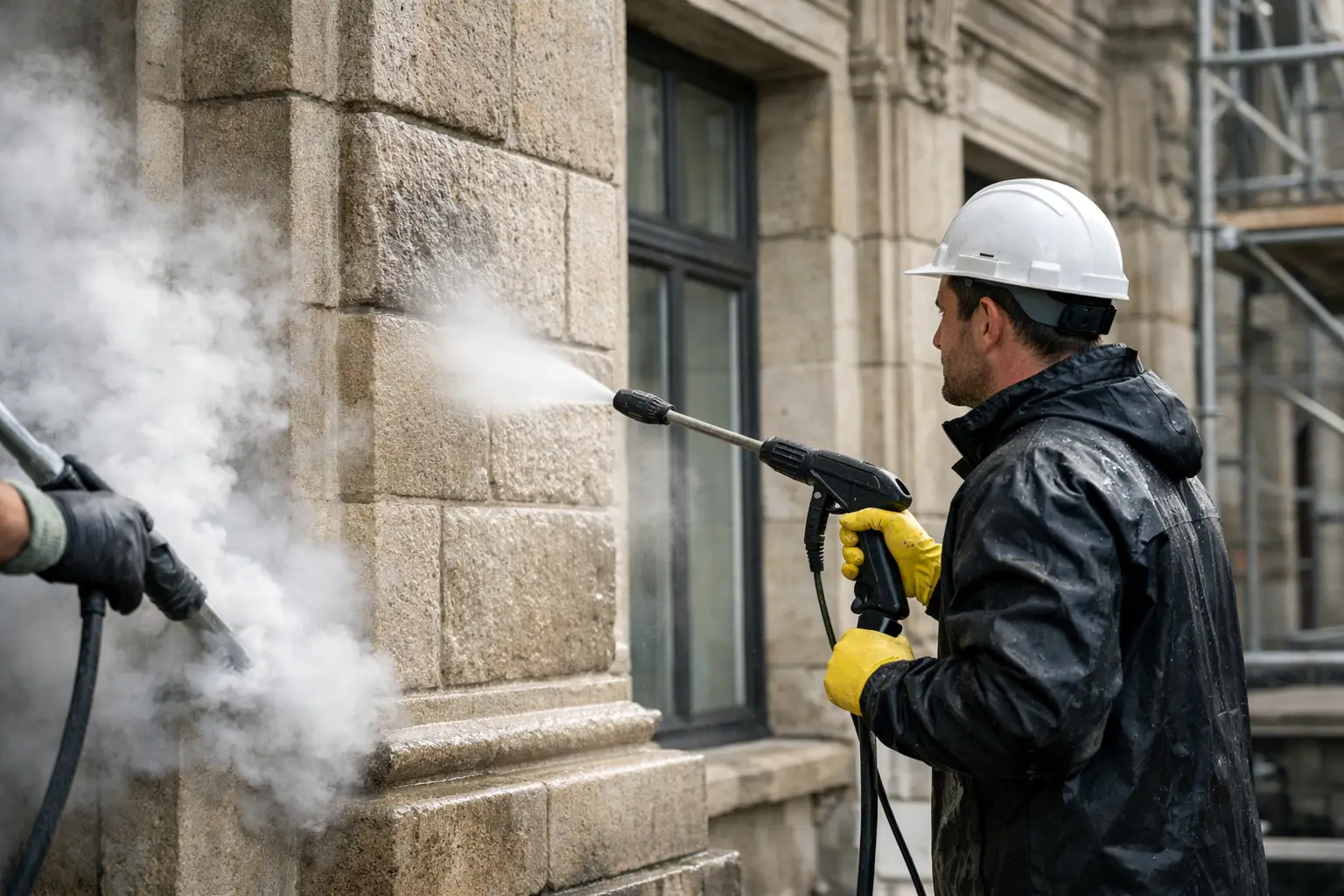
A stone facade can look permanently solid while quietly collecting contaminants that shorten its service life. The most effective stone facade cleaning techniques do more than improve curb appeal. They remove damaging deposits without weakening the stone, staining the surface, or forcing water into joints and cavities.
For building managers, the right approach starts with a simple principle: stone is not one material. Granite, marble, limestone, sandstone, travertine, engineered stone, and cast stone respond differently to water, chemicals, pressure, and abrasion. A cleaning method that works on dense granite may permanently etch polished marble or erode soft sandstone. This is why facade cleaning should be planned as a material-specific maintenance task, not treated as a general wash-down.
Why Stone Facades Deteriorate in Urban Conditions
Stone surfaces on commercial and residential buildings are exposed to a continuous mix of airborne dust, vehicle exhaust, rainwater, mineral deposits, bird droppings, algae, and organic growth. In Malaysia’s hot, humid climate, moisture can remain on shaded elevations long enough to encourage mold, algae, and black biofilm. These marks are not only visual concerns. They can hold moisture against the facade and make early defects harder to identify.
Rain does not clean every part of a building evenly. Horizontal ledges, recessed window bands, undersides of projections, and areas below air-conditioning discharge often develop concentrated staining. Water runoff can also carry dirt across the face of stone panels, leaving streaks that become more visible after repeated wet and dry cycles.
The operational risk is just as relevant as appearance. A soiled facade can conceal cracked sealant, open joints, spalled stone, corroding anchors, or failed drainage details. Cleaning creates an opportunity for a close visual inspection, provided the team is trained to recognize facade defects rather than simply remove surface dirt.
Stone Facade Cleaning Techniques by Soil Type
The correct technique depends on both the stone and the contamination. A condition survey should identify the stone type, finish, jointing materials, prior coatings, visible damage, drainage paths, and the likely cause of staining. Cleaning without this assessment can spread the problem or create a new one.
Low-Pressure Water Rinsing for Loose Dirt
Low-pressure water rinsing is often the first and least aggressive step for dust, light pollution film, and fresh surface deposits. The work should proceed from the top downward in controlled sections, using enough water to rinse contaminants away without saturating joints or driving water behind panels.
Pressure must be selected carefully. High-pressure equipment may appear efficient, but it can roughen soft stone, strip mortar, disturb sealant, and force moisture into cracks. Even hard stone can be damaged when a narrow jet is held too close to the surface. Water is a useful cleaning medium, but it is not automatically harmless.
pH-Neutral Detergent Cleaning for General Grime
For accumulated urban dirt and oily atmospheric film, a pH-neutral cleaner is commonly the safest starting point. The detergent is applied at a controlled dilution, allowed a short dwell time, and gently agitated with soft brushes or non-abrasive pads before thorough rinsing.
This method is especially useful where a facade has an even gray film rather than isolated stains. It also reduces the temptation to use aggressive chemicals too early. On polished or honed stone, gentle agitation matters. Abrasive tools can dull the finish and create uneven patches that are difficult to correct across a large elevation.
Biocide Treatment for Algae, Mold, and Biofilm
Green, black, or dark brown growth on shaded areas is often biological. Simply washing it away may improve appearance temporarily, but surviving spores can return quickly. A compatible biocide treatment is usually required to address the growth at its source.
The selected product must suit the stone, nearby sealants, glazing, metalwork, landscaping, and drainage system. It should be applied in a measured way, given adequate contact time, and rinsed or neutralized according to its technical requirements. Runoff control is essential, particularly on occupied properties where entrances, balconies, and public walkways remain in use.
Poultice Cleaning for Localized Stains
Poultices are appropriate for certain localized stains that have absorbed into porous stone, including rust, oil, or deep organic discoloration. A poultice draws contaminants from the stone as it dries, rather than relying on forceful surface washing.
This process requires diagnosis. Rust staining may come from embedded ferrous particles, corroding fixings, or runoff from adjacent metal components. If the underlying source remains active, the stain will return. Cleaning should therefore be coordinated with repairs to anchors, flashings, fixings, or drainage details where necessary.
Specialist Treatments for Mineral and Cement Deposits
White mineral deposits, cement haze, and efflorescence require particular caution. Acidic products can react aggressively with calcareous stones such as limestone, marble, and travertine. They may cause etching, loss of polish, or permanent color variation.
Efflorescence is also a moisture signal. The salts are deposited when water moves through masonry or joints and evaporates at the surface. Removing visible salts without investigating water ingress only treats the symptom. The more durable response may involve repairing joints, sealant, coping details, or drainage routes before repeat cleaning is considered.
A Safe Process for Cleaning Stone at Height
High-rise stone cleaning is an access and safety operation as much as a cleaning task. Rope access can be highly effective for irregular elevations, recessed facade zones, and locations where suspended platforms are impractical. However, the access method must be selected after reviewing the building layout, anchor arrangement, work zones, weather exposure, and protection of people below.
A professional work plan should include a pre-cleaning inspection, a test area, method statements, safe access procedures, exclusion zones, runoff management, and post-cleaning checks. The test area is particularly valuable because it confirms whether the proposed detergent, dwell time, brush type, and rinsing method achieve an acceptable result without altering the stone.
Cleaning should not proceed when wind, lightning risk, or heavy rain makes exterior access unsafe or prevents proper control of water and chemicals. For occupied buildings, scheduling also matters. Work around entrances, tenant-facing glazing, parking areas, and public circulation routes should be organized to minimize disruption while maintaining a clear safety perimeter.
What to Avoid on a Stone Facade
Several common shortcuts create avoidable damage. Avoid using high-pressure jets as a default solution, especially on aged mortar, porous stone, open joints, and decorative detailing. Avoid strong acids on unknown stone types. Avoid wire brushes, harsh scouring pads, and uncontrolled chemical mixing.
It is also unwise to clean only the visibly dirty areas. Spot cleaning can leave obvious tonal differences, particularly on natural stone that has weathered unevenly. Where practical, cleaning should be carried out in logical full sections, with consistent application and rinsing so the finished facade looks uniform.
Finally, do not apply water-repellent coatings simply because the stone appears dirty. A coating may be useful in specific circumstances, but only after moisture movement, compatibility, vapor permeability, and substrate condition have been assessed. A poorly selected coating can trap moisture and complicate future maintenance.
Build Cleaning Into a Facade Maintenance Plan
The best cleaning interval depends on the building’s location, stone type, orientation, surrounding traffic, shading, and exposure to rain. A tower beside a busy roadway or construction activity may need more frequent attention than a sheltered development in a lower-pollution setting. North- or shade-facing elevations may need more targeted biological treatment than sun-exposed faces.
Rather than waiting for a facade to look visibly neglected, building teams should use regular inspections to identify early staining, blocked drainage paths, failed sealant, and biological growth. Recording the condition of each elevation also helps maintenance teams distinguish recurring issues from isolated events.
For property stakeholders, the objective is not an aggressively bright surface. It is a clean, even, stable facade that retains the character of its original stone and continues to perform as intended. When cleaning, inspection, repairs, and safe access are planned together, facade maintenance becomes a practical safeguard for the building’s appearance, durability, and reputation.
Technique selection guide
| Condition | Possible starting method | Main caution |
|---|---|---|
| Loose dust and surface dirt | Low-pressure water and soft agitation | Avoid forcing water into joints |
| General urban grime | Stone-compatible neutral cleaner | Confirm dwell time and rinse requirements |
| Algae or biofilm | Compatible biocidal treatment | Protect landscaping and manage runoff |
| Localised deep staining | Specialist poultice after testing | Colour change and residue must be checked |
Frequently asked questions
Can pressure washing damage stone?
Yes. Excessive pressure can erode softer stone, widen joints and drive moisture deeper into the assembly. Pressure, distance and nozzle selection must be tested.
Why is a test patch necessary?
It reveals whether the proposed method removes the stain evenly without etching, bleaching, roughening or leaving residue.
Plan a safe cleaning trial
Request a site assessment and test-cleaning proposal from Vertical Pro.
Where inspection or maintenance involves work at height, access planning should follow a documented risk-control process. DOSH Malaysia’s fall-prevention guidance is a useful reference for that planning.





Leave a Reply