
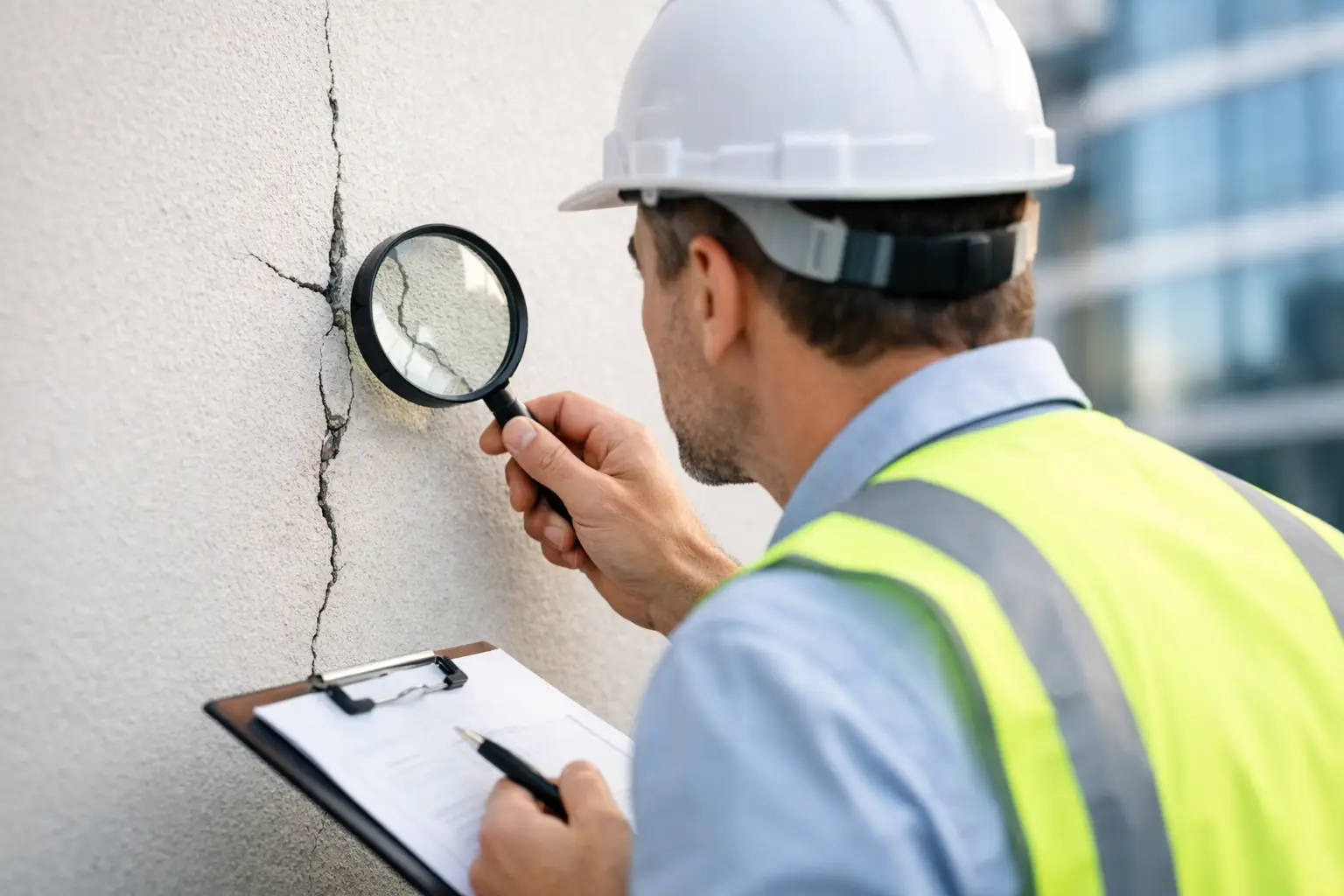
A hairline crack beside a window on the tenth floor can look minor from the ground. A month later, after repeated rain exposure and thermal movement, that same crack may be holding moisture, staining the facade, and signaling a larger maintenance issue. That is why knowing how to inspect facade cracks matters for any team responsible for building safety, appearance, and long-term asset performance.
Facade cracks are not all the same. Some are cosmetic and stable. Others indicate movement, water entry, material failure, or poor detailing around joints and penetrations. A useful inspection is not just about spotting a line in the wall. It is about understanding what type of crack you are seeing, where it appears, how it behaves, and what risk it creates if left unattended.
How to inspect facade cracks without missing the real issue
A proper facade crack inspection starts before anyone looks up at the building. Review the building’s age, facade material, repair history, and any recent complaints about leaks, falling debris, or recurring stains. If the property has gone through repainting, sealant replacement, restoration work, or nearby structural changes, those details can help explain why cracking may now be visible.
The next step is to define the inspection objective. In some cases, the goal is routine condition assessment. In others, it is a targeted response to specific symptoms such as water infiltration, bulging finishes, or cracking that appears to be spreading. The inspection method should match that objective. A quick visual scan from the ground may help identify obvious distress, but it will not replace close-range assessment where elevated areas, joints, corners, and transitions can be examined safely.
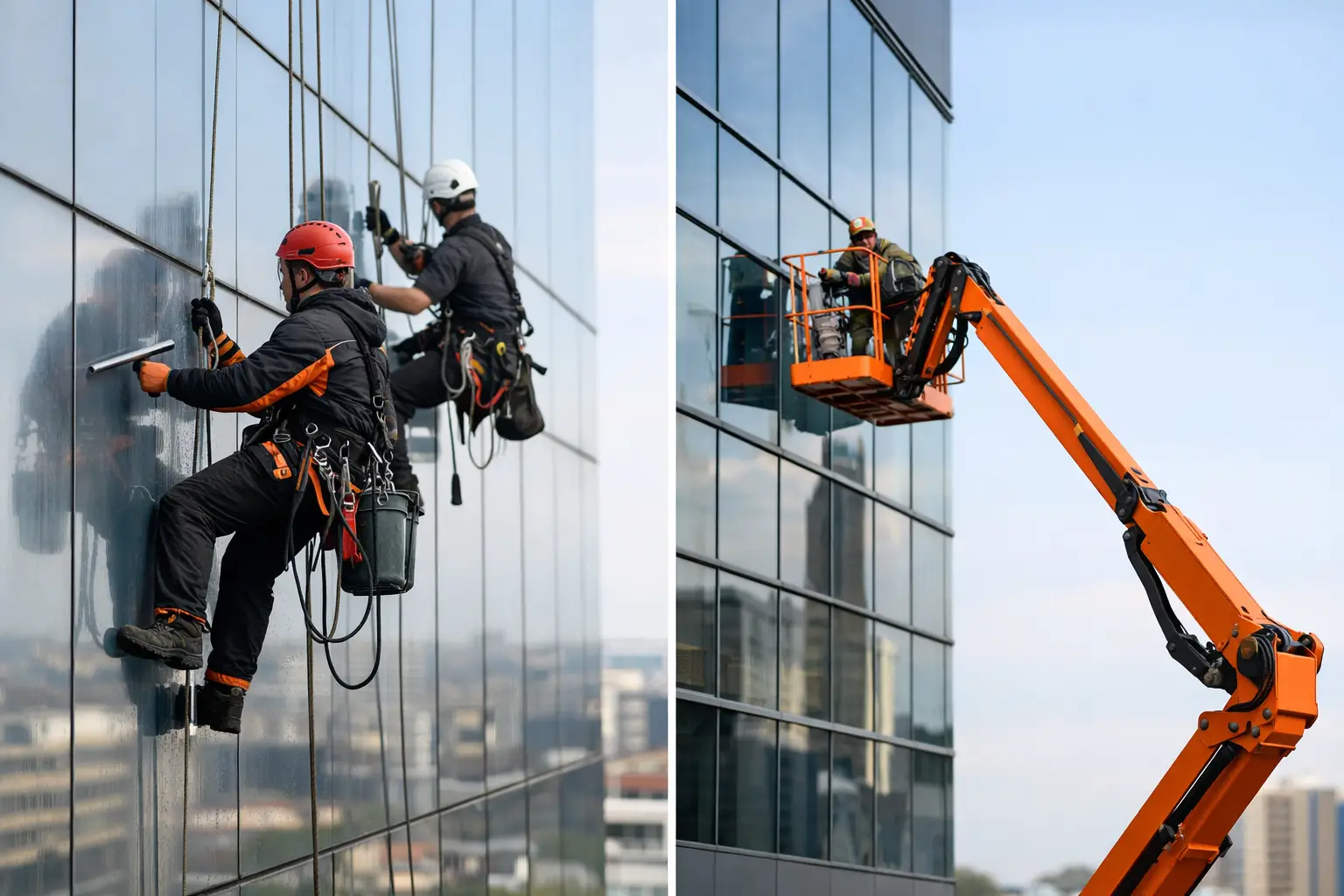
For high-rise properties, access planning is part of the inspection itself. Cracks often develop in locations that are difficult to evaluate from common vantage points, including facade returns, parapets, movement joints, undersides of projections, and perimeter wall areas near glazing. In these situations, rope access, suspended platforms, or other safe work-at-height methods may be necessary to get reliable findings.
Start with a visual pattern, not a single crack
When inspecting facade cracks, look for patterns first. A single isolated hairline crack in render may have a different meaning than repeated diagonal cracks at multiple corners or vertical cracking aligned with slab edges. Pattern recognition helps distinguish localized finish defects from issues related to substrate movement, differential settlement, thermal stress, corrosion, or failed joints.
Map the crack locations across the elevation. Note whether they appear around windows, at floor lines, along expansion joints, near beam-column interfaces, or in repaired areas. Also record orientation. Vertical, horizontal, diagonal, stepped, and random map cracking each suggest different causes. The shape and distribution often matter more than width alone.
It also helps to look beyond the crack itself. Check for staining, biological growth, efflorescence, peeling coatings, hollow render, displaced sealant, corrosion marks, or spalled concrete nearby. These companion symptoms can show that the facade is not just cracked but already allowing moisture intrusion or losing adhesion.
What to check during a close-range inspection
Close-range facade crack inspections should be methodical. Measure or estimate crack width, note crack length, and record whether the crack appears active or dormant. If edges are clean and sharp with no sign of movement, the crack may be stable. If the crack shows widening, offset surfaces, repeated reappearance after patching, or fresh staining after rain, it deserves closer technical review.
Pay attention to depth as well. Surface-level crazing in coatings differs from a crack that extends through render, masonry joints, precast panels, or concrete elements. A superficial finish crack may affect appearance and water resistance, but a deeper crack can indicate substrate distress. Tapping surrounding areas can sometimes reveal debonded finishes, although interpretation should be done by experienced personnel.
Joints and transitions deserve special attention. Many facade failures begin where different materials meet, such as concrete to infill wall, frame to wall, or panel edge to sealant joint. These interfaces move differently under heat, moisture, and structural loading. If cracks are concentrated at such points, the issue may be less about isolated damage and more about movement accommodation that is no longer performing as intended.
How to inspect facade cracks in Malaysia’s climate
In Malaysia, facade inspections should account for intense UV exposure, heavy rainfall, high humidity, and repeated wet-dry cycles. These conditions accelerate coating breakdown, joint fatigue, moisture absorption, and thermal expansion effects. Cracks that seem minor during a dry period may become more significant once water repeatedly enters the system.
This climate also makes moisture clues especially important. Dark staining below cracks, algae growth, blistering paint, and salt deposits can indicate prolonged water movement through the facade. On high-rise buildings, wind-driven rain can force moisture into openings that are not obvious from a surface-level view.
That is why timing matters. If possible, compare observations made during dry weather with findings after heavy rain. Some cracks become far more readable when leak paths, damp patches, or fresh runoff marks are visible. For building managers, this can turn a vague concern into a documented maintenance priority.
Common crack types and what they may suggest
Hairline surface cracks in paint or skim coats are often cosmetic, but they should still be monitored if they appear extensively or allow water retention. Shrinkage cracks in render may develop from curing issues or material movement, especially on broad wall surfaces.
Diagonal cracks near window corners are common stress points and may indicate movement concentration around openings. Horizontal cracking can be associated with slab edge movement, reinforcement corrosion, or interface distress. Vertical cracks may result from thermal movement, material separation, or substrate joints reflecting through finishes. Stepped cracking in masonry can suggest movement through mortar joints rather than just coating failure.
None of these patterns should be interpreted in isolation. The same crack shape can have different causes depending on facade type, age, exposure, and repair history. This is where experience matters. A correct diagnosis depends on seeing the crack in context, not just naming the pattern.
Documentation is part of the inspection, not an afterthought
Good records make crack inspections more useful over time. Take clear photographs at wide, mid, and close range. Mark locations on elevation drawings or annotated facade photos. Record dimensions, orientation, nearby symptoms, and any suspected triggers such as failed sealant, drainage issues, or corroded areas.
If there is concern that a crack is active, establish a monitoring approach. That may involve dated photographic comparison, crack gauges, or scheduled reinspection after weather events. Monitoring is especially useful when the crack is not yet severe enough to justify immediate invasive work but still presents uncertainty.
For managed properties, documentation also supports internal reporting, maintenance planning, and risk control. A facade issue that is properly recorded can be prioritized before it becomes a tenant complaint, water ingress problem, or safety hazard.
When a crack becomes a safety concern
Not every crack is urgent, but some conditions should never be left to routine observation. If cracking is accompanied by bulging render, loose tiles, spalling concrete, rust staining, displaced panels, or visible separation at height, the issue may involve falling-object risk. In that case, the priority shifts from diagnosis alone to immediate safety management.
Water ingress also raises the stakes. Once cracks allow moisture into the facade assembly, secondary damage can spread into coatings, insulation, reinforcement, internal finishes, and occupied spaces. What starts as a narrow visible defect can become a much broader durability problem.
For high-rise buildings, access limitations can hide the true extent of deterioration. Ground-level assumptions are often unreliable. A professional facade specialist with safe access capability can inspect areas that standard maintenance teams cannot reach and identify whether the problem is superficial, systemic, or already affecting the substrate.
Why professional facade inspection often saves time later
Building teams can and should identify visible warning signs early. But there is a point where visual awareness must give way to technical assessment. If cracking is widespread, recurring, leaking, elevated, or associated with detachment risk, specialist inspection is the responsible next step.
A facade-focused contractor or consultant brings more than access equipment. They bring material knowledge, failure pattern recognition, and the ability to connect cracking with movement, moisture, detailing, and maintenance history. For complex buildings, that perspective reduces guesswork and helps avoid repairs that only mask the symptom.
At Facade by Vertical Pro Sdn Bhd, this is where facade care becomes a practical asset management decision rather than a reactive patching exercise. The goal is not simply to close a crack. It is to understand what the facade is telling you and respond before minor exterior defects turn into larger operational problems.
The most useful inspection mindset is simple: treat every crack as information. Some will prove harmless. Others will reveal movement, water entry, or aging materials that need prompt attention. The earlier those signals are read clearly, the easier it is to protect the building above, below, and behind the facade.
Discuss the next step
For advice on facade crack inspection, request a site assessment or quotation from Vertical Pro.
For rope access work, planning, supervision, competence and equipment need to operate as one system. IRATA International’s overview of rope access explains why each part matters to safe execution.




Leave a Reply