

When a facade issue appears 20 or 30 stories up, access stops being a logistics detail and becomes the job itself. That is why the question of rope access vs scaffolding matters so much for property owners and building managers. The access method affects safety planning, work speed, tenant disruption, inspection quality, and how effectively a maintenance team can reach the parts of the building that actually need attention.
For facade work, there is no single method that suits every building. Rope access can be highly effective for targeted, high-elevation tasks. Scaffolding can be the better choice when crews need broad, stable coverage over a larger area. The right decision depends on the building, the condition of the facade, the nature of the work, and how much physical presence the job requires.
Rope access vs scaffolding for facade work
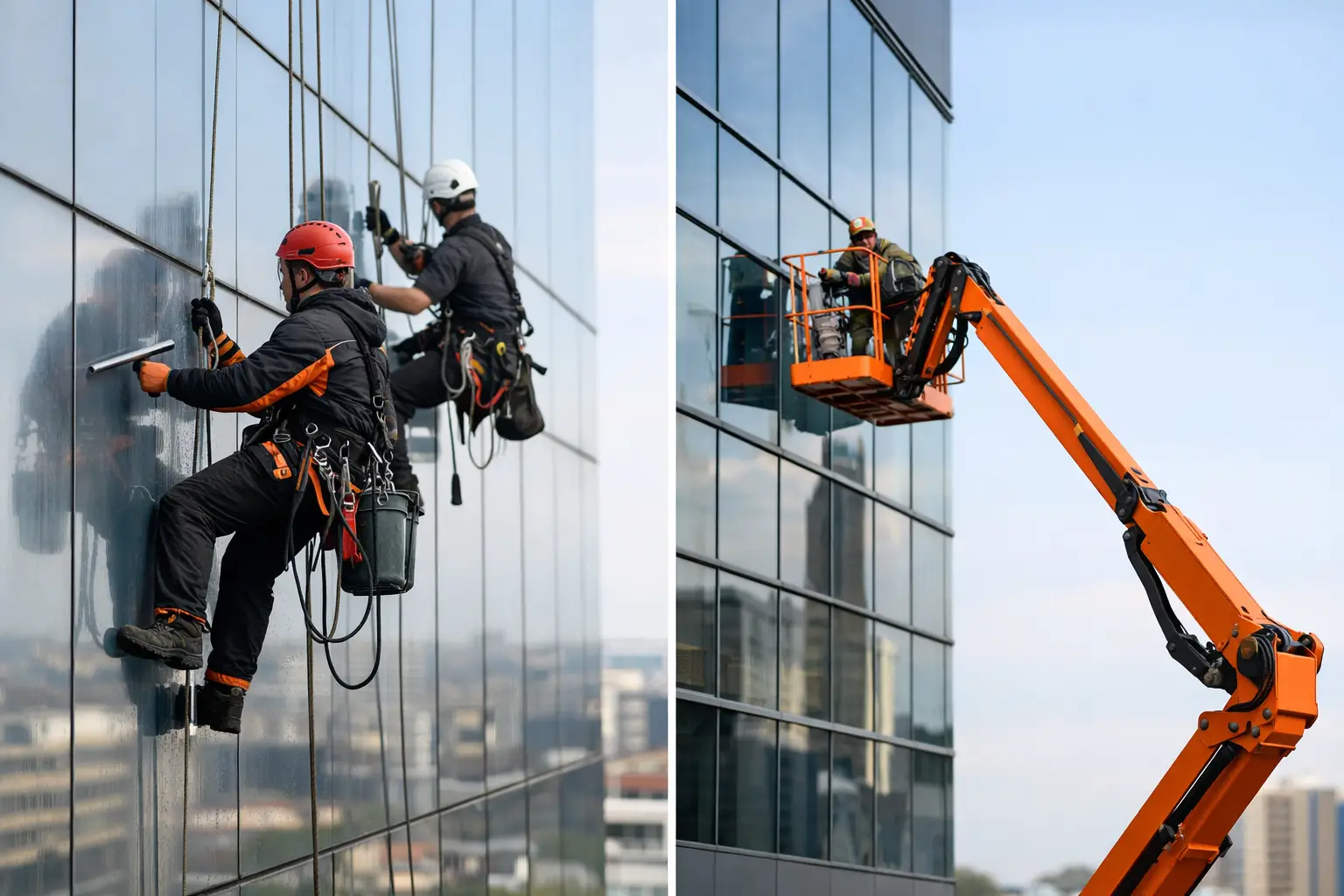
In facade maintenance, rope access uses trained technicians suspended by ropes and anchor systems to inspect, clean, repair, or restore exterior surfaces at height. It is a specialized access method designed for difficult-to-reach areas, particularly on high-rise structures where direct vertical movement is more efficient than building a full temporary platform.
Scaffolding, by contrast, creates a fixed working structure attached or erected around portions of the building. It provides a stable platform for workers, tools, and materials over a longer duration. That makes it useful for jobs that require repeated access to the same facade zone, close manual work across wide surfaces, or support for heavier equipment and materials.
For building stakeholders, the comparison is less about which method is better in general and more about which method is better for the specific maintenance objective.
Where rope access is often the stronger choice
Rope access is particularly well suited to inspection-led and targeted facade work. If a property team needs close visual assessment of sealant failure, localized crack repair, facade cleaning in selected elevations, or access to difficult corners and recessed surfaces, rope systems can provide precise reach with limited setup footprint.
This matters on occupied buildings. Office towers, residential developments, and mixed-use assets often cannot tolerate large access structures around entrances, drop-off zones, retail frontages, or pedestrian pathways for extended periods. Rope access reduces ground-level congestion and usually allows work to be carried out with less interference to daily building use.
It also offers a practical advantage in complex architecture. Modern facades often include setbacks, fins, ledges, curved surfaces, and mixed cladding systems. Heritage buildings can present even more irregular conditions. In these situations, technicians working on rope can often reposition more efficiently than crews relying on scaffold sections that must conform to the building geometry.
For Malaysia’s high-rise environment, rope access is also valuable when rapid response is needed. Tropical rainfall, humidity, UV exposure, and urban pollution can accelerate facade deterioration in ways that are not always evenly distributed. A building may not need full-surface intervention. It may need focused access to investigate staining, water ingress points, loose elements, or isolated surface failure.
That said, rope access works best when the task fits the method. It is excellent for mobility and precision, but it is not intended to replace every form of elevated work platform or structural access system.
Where scaffolding remains the better option
Scaffolding becomes more appropriate when the job requires a large working face, continuous occupation of one facade section, or substantial material handling. If a project involves extensive restoration, heavy surface treatment, widespread removal and replacement, or long-duration repairs across the same elevation, a fixed platform may support better workflow.
Workers on scaffolding have a standing surface, easier staging for tools and materials, and a more constant working position. For tasks that demand repetitive handwork over broad areas, that stability can improve consistency. Scaffolding can also make sense for lower-rise sections where installation is practical and the facade treatment is substantial enough to justify it.
There is also a sequencing advantage in some restoration projects. When multiple trades need access to the same area in succession, a scaffold system may allow better coordination than repeated mobilization on rope. This is especially true if work must proceed layer by layer across coatings, repairs, and finishing stages.
The trade-off is physical presence. Scaffolding is more intrusive around the building perimeter, can affect access routes and visual presentation during the project, and may be less adaptable on towers with tight urban footprints or complicated facade profiles.
Safety is not about the method alone
In discussions about rope access vs scaffolding, safety is often framed as a contest. That is not the right lens. Both methods can be safe when they are properly engineered, planned, supervised, and executed by competent specialists. Both can also introduce risk if used outside their appropriate scope.
For rope access, safety depends on certified technicians, redundant systems, anchor integrity, rescue planning, weather assessment, and strict operating procedures. For scaffolding, safety depends on correct design, stable erection, load control, inspection routines, edge protection, and proper use over the life of the structure.
The real question for a building owner is whether the chosen access method matches the task and the building conditions. A poor method choice can create unnecessary exposure, inefficiency, or operational disruption even if the equipment itself meets technical standards.
This is one reason facade-specific expertise matters. Access planning should start with the facade system, not just the height of the building. Cladding type, surface condition, vulnerable architectural details, occupant movement, and maintenance objectives all affect which access approach is appropriate.
Speed, disruption, and operational impact
For occupied properties, operational continuity is often a major concern. Rope access generally has an advantage when the goal is to complete focused work with limited impact on the site. Setup is typically lighter, access can be concentrated on specific zones, and there is often less obstruction at street or podium level.
That can be especially useful on commercial buildings where tenant perception matters, or residential properties where resident movement and common-area access must remain manageable. For high-rise assets in dense urban areas such as Kuala Lumpur, minimizing perimeter disruption can be just as important as reaching the facade itself.
Scaffolding, however, may support steadier production once installed for projects that cover the same area over time. If the work requires a constant platform and multiple passes across the surface, the initial setup burden may be justified by the working conditions it creates.
This is where broad assumptions can be misleading. Rope access is not automatically the faster option in every scenario, and scaffolding is not automatically the more disruptive choice in every project. The building shape, scope of work, and duration all influence the result.
How to choose the right method for your building
The best access decision starts with diagnosis. Before selecting a method, building stakeholders should understand what kind of facade work is actually required. Is the task investigative or repetitive? Is it localized or extensive? Does it involve light tools and close inspection, or does it require material support across a large area?
A good assessment should also consider the building envelope itself. Curtain wall systems, painted concrete, stone facades, metal panels, glazing details, and decorative features all present different access and protection requirements. An access strategy that suits one facade type may be inefficient or unsuitable for another.
Building use is another practical factor. A corporate office tower, occupied condominium, hotel, or heritage property will each have different tolerances for noise, obstruction, visual impact, and work staging. The right method is the one that supports the maintenance objective while protecting daily operations and the long-term condition of the exterior.
In many cases, the answer is not strictly one or the other. Some projects benefit from a combined approach. Rope access may be used for inspection, testing, and targeted repair at upper elevations, while scaffolding is used only where lower-level restoration requires a sustained working platform. Matching methods to zones of work often creates a more controlled and efficient maintenance plan than forcing one system across the entire project.
The facade should lead the decision
Access methods are not just site logistics. They shape how well a team can inspect deterioration, protect architectural surfaces, and complete maintenance with control. For facade owners and managers, that makes the rope access vs scaffolding decision a building performance question, not only a contractor preference.
If the work is precise, elevated, and difficult to reach, rope access often provides the flexibility needed to address facade issues without unnecessary site intrusion. If the project is broad, material-intensive, and centered on one area for an extended period, scaffolding may offer the right working environment.
The most dependable path is to evaluate the facade first, define the scope clearly, and choose the access method that serves the building – not the other way around. When that decision is made carefully, maintenance becomes more than a response to visible defects. It becomes a disciplined step toward preserving safety, appearance, and long-term asset condition.
Discuss the next step
For advice on rope access vs scaffolding, request a site assessment or quotation from Vertical Pro.
For rope access work, planning, supervision, competence and equipment need to operate as one system. IRATA International’s overview of rope access explains why each part matters to safe execution.



Leave a Reply